

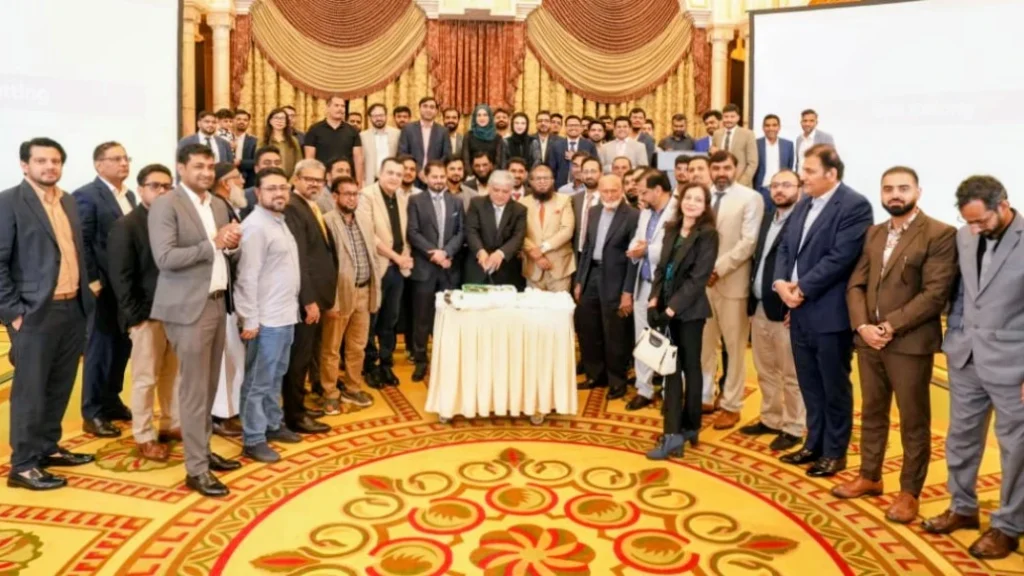
As the UAE accelerates the digital transformation of its tax ecosystem, e-Invoicing and its impact on businesses took centre stage at the UAE E-Invoicing Boot Camp 2026, hosted by the UAE Chapter of the Institute of Chartered Accountants of Pakistan (ICAP) at InterContinental Abu Dhabi on August 13, 2026.
The event brought together finance, tax, compliance and technology professionals to examine what the transition to e-Invoicing will mean for UAE businesses from regulatory readiness and internal controls to technology integration and the way financial data will move between businesses and the tax ecosystem.
A key highlight of the evening was the participation of Abdulla Al Bastaki, Chief Executive Officer of the Information Technology Sector at the Federal Tax Authority (FTA), who addressed the gathering on the UAE’s e-Invoicing journey and the wider digital transformation of tax administration.
Al Bastaki was joined by representatives from the Federal Tax Authority, further strengthening the Authority’s presence at the event and providing the finance and business community with a valuable opportunity to engage with the regulator as the UAE prepares for this important transition.
The FTA’s participation added particular significance to an evening that sought to move the conversation beyond simply complying with another tax requirement.
Discussions highlighted e-Invoicing as part of the UAE’s broader digital transformation with the potential to enhance transparency, data quality, business efficiency and connectivity across the tax ecosystem.
The UAE has steadily expanded the digitalisation of its government and tax infrastructure in recent years, and e-Invoicing represents another important step in that evolution. For businesses, however, the transition is expected to involve much more than changing the format of an invoice.
That message ran throughout the Boot Camp: e-Invoicing is as much a finance and technology transformation as it is a tax compliance exercise.
The technical discussions began with Muhammad Aaliyan, Managing Partner at ADEPTS Chartered Accountants, and Vikash Bhuwania, Associate Director – Tax, Risk & GRC at ADEPTS, who addressed the tax and regulatory perspective and the issues organisations should consider as they prepare for implementation.
The compliance dimension was taken forward by Muhammad Rizwan Khan, Senior Partner & Global Compliance Head at AJMS Global, who discussed how regulatory requirements need to be incorporated into business processes, governance structures and internal control frameworks rather than treated as a standalone tax exercise.
Technology then moved from discussion to demonstration.
Sangmesh Hiremath, Co-Founder and CEO of Marmin AI, walked the audience through the “Journey of an E-Invoice – C1 to C4 through C5” and demonstrated the Marmin platform as an Accredited Service Provider solution, giving attendees a practical view of how an e-Invoice can move through the technology ecosystem.
The discussions highlighted a challenge that UAE organisations will increasingly need to address: e-Invoicing cannot be owned by one department alone. Finance, tax, IT, compliance and senior management will need to work together as businesses assess systems, data, processes and controls ahead of implementation.
The event also brought a broader professional and economic perspective through H.E. Shafqat Ali Khan, Ambassador of Pakistan to the United Arab Emirates, who attended as Chief Guest.
Addressing the gathering, the Ambassador spoke about the longstanding economic relationship between Pakistan and the UAE and recognised the contribution Pakistani professionals, including Chartered Accountants, continue to make to the UAE’s economy and institutional development.
tanvir@dubainewsweek.com
