
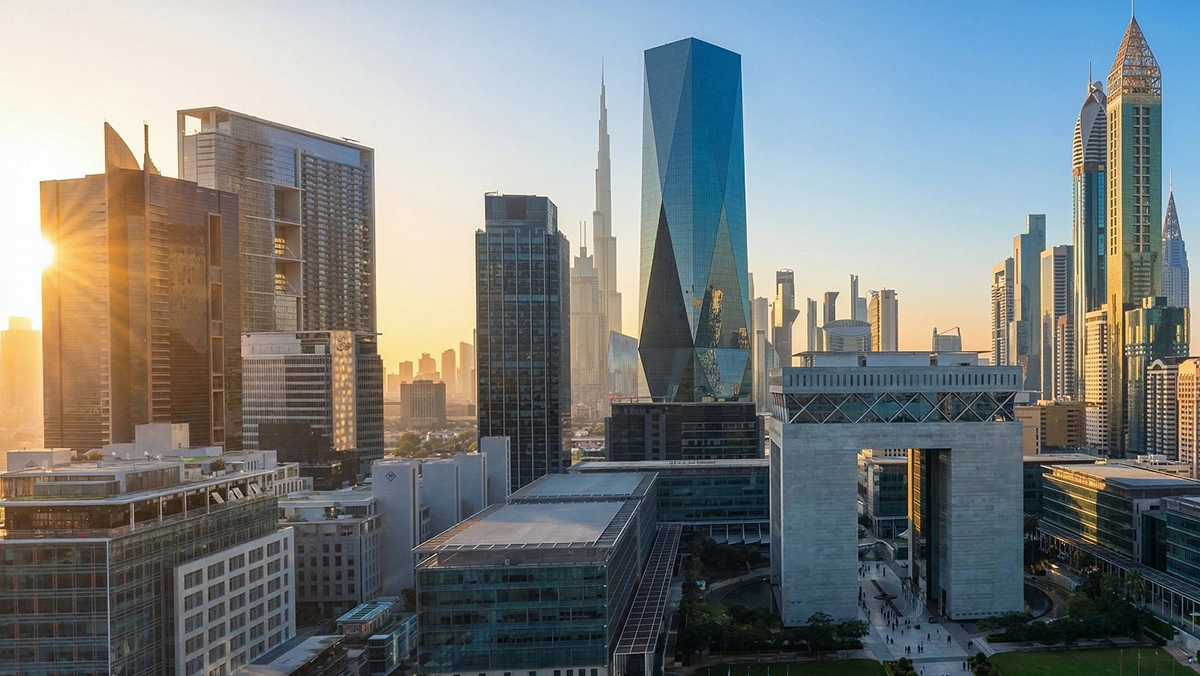
The Dubai International Financial Centre (DIFC) has announced plans to become the world’s first AI-native financial centre, integrating artificial intelligence across its legal, regulatory and physical systems.
AI-driven transformation
The move by Dubai International Financial Centre aims to embed AI into core operations rather than limiting it to pilot projects or support functions. The initiative will cover legal frameworks, business processes, talent development and infrastructure across the district.
The centre said the approach builds on its 2023 AI strategy, which introduced data governance policies and incorporated AI under Regulation 10 of the DIFC Data Protection Law.
Economic impact forecast
DIFC estimates that the AI-native programme could generate USD 3.5 billion (Dhs 12.9 billion) in economic value and create around 25,000 jobs. It also expects to strengthen Dubai’s position as a global hub for financial technology and AI-driven services.
His Excellency Essa Kazim, Governor of DIFC, said: “DIFC’s evolution into the world’s first AI-Native financial centre marks a defining step in Dubai’s ascent as a global capital for the future of finance. As artificial intelligence reshapes the international financial landscape, this initiative reinforces Dubai’s role in setting new standards for innovation, trust and competitiveness. In line with the Dubai Economic Agenda D33, it underscores our commitment to building a resilient, forward-looking economy and positioning the emirate at the forefront of responsible AI adoption in financial services worldwide.”
His Excellency Arif Amiri, Chief Executive Officer of DIFC Authority, said: “Today we are announcing that DIFC will become the world’s first AI-Native Financial Centre. This is not about experimenting with AI at the edges; it is about embedding AI across our legal frameworks, regulatory systems, talent development and physical infrastructure. By doing so, DIFC will set a global benchmark for AI governance and responsible innovation, while delivering tangible impact, including USD 3.5 billion (Dhs 12.9 billion) in economic value and the creation of 25,000 new jobs.”
Regulatory framework
As part of the transition, DIFC will introduce governance systems covering both human and AI-driven activity, including autonomous agents and robotics. AI tools will also be used across compliance, enterprise operations and financial services delivery.
The centre said it aims to become a leading global destination for AI-focused financial firms, with targets linked to start-up density, venture capital activity and unicorn creation.
Workforce and training
DIFC plans to expand executive education, technical certification and regulatory training programmes to support human–AI collaboration. It will also use AI tools internally to improve productivity and decision-making.
Smart infrastructure plans
By 2030, DIFC expects a significant share of its district to include smart buildings, autonomous mobility systems, service robotics and digital twin technology. Thousands of sensors will be deployed across the area to support real-time management.
The development is also expected to improve energy efficiency, with some maintenance and security functions handled by robotics.
Regional position
DIFC said the project aligns with Dubai’s wider digital and economic strategies, including the Dubai Economic Agenda D33, and supports the UAE’s focus on advanced technology and innovation-driven growth.
tanvir@dubainewsweek.com
