
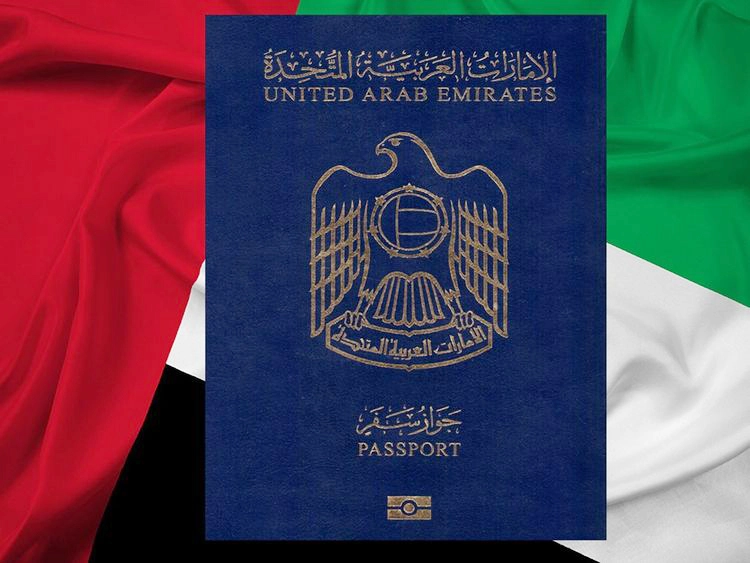
The UAE has strengthened its position as the holder of the world’s most powerful passport, reaching a record score of 182, according to new data released by The Passport Index by Arton Capital. This marks the highest score ever recorded in the index’s history.
The UAE has maintained the top global ranking since 2018, reflecting a steady rise in diplomatic engagement and international agreements that have expanded global mobility for Emirati citizens. The latest figures show continued growth in visa-free access, giving UAE passport holders wider access to global markets, business hubs and tourism destinations.
The Passport Index noted that the UAE’s progress has been supported by sustained international outreach, including the UAE Passport Force Initiative launched by the Ministry of Foreign Affairs in 2017. Since then, the country’s ranking has improved significantly, moving from 88th place globally to the top position within less than a decade.
The report showed mixed performance across Asia. Singapore retained second place with a score of 175, while Malaysia remained the only other Asian country in the top tier, holding 17th place.
Despite Asia contributing nearly half of global GDP growth in 2026, the region did not see corresponding gains in passport strength. South Korea and Japan each dropped four positions, with South Korea falling out of the top 20 entirely.
Europe leads rankings
European countries continued to dominate the top tier of global passport rankings. Spain, Belgium, Luxembourg, France and Denmark remained among the strongest passports worldwide.
Luxembourg recorded a notable rise, climbing from 10th to 5th place with a score of 174, driven in part by its ambition to position itself as a European artificial intelligence and technology hub. This shift pushed Finland out of the top 10 in 2025.
Shifts in travel access
The Passport Index’s Welcoming Countries ranking showed declines for Australia, the United States, Canada and New Zealand, reflecting tighter visa rules and evolving border systems. In contrast, the United Kingdom moved up two places despite the introduction of mandatory Electronic Travel Authorisations (ETAs).
Several European countries also saw declines in their welcoming rankings, linked to the rollout of ETIAs across 30 countries. This resulted in 34 countries shifting from a welcoming score of 55 to 56. At the same time, some passports such as Armenia recorded lower individual mobility scores of 80.
Armand Arton, CEO of Arton Capital and co-founder of the Passport Index, said: “This is a standout year for The Passport Index, with record highs achieved by the UAE. Despite ongoing geopolitical tensions, the UAE remains unshakeable in its relevance on the global stage. Bar notable exceptions, like Singapore, it remains an outlier in continuing to expand access for its passport holders.
“We anticipate that 2027 will generate ever greater disparities in individual passport power due to the potential for further global unrest, coupled with tightening restrictions and lower world openness. As global movement and accessibility become a necessity rather than a luxury, a powerful passport will increasingly become a critical dividing line between the haves and have-nots.”
tanvir@dubainewsweek.com
