
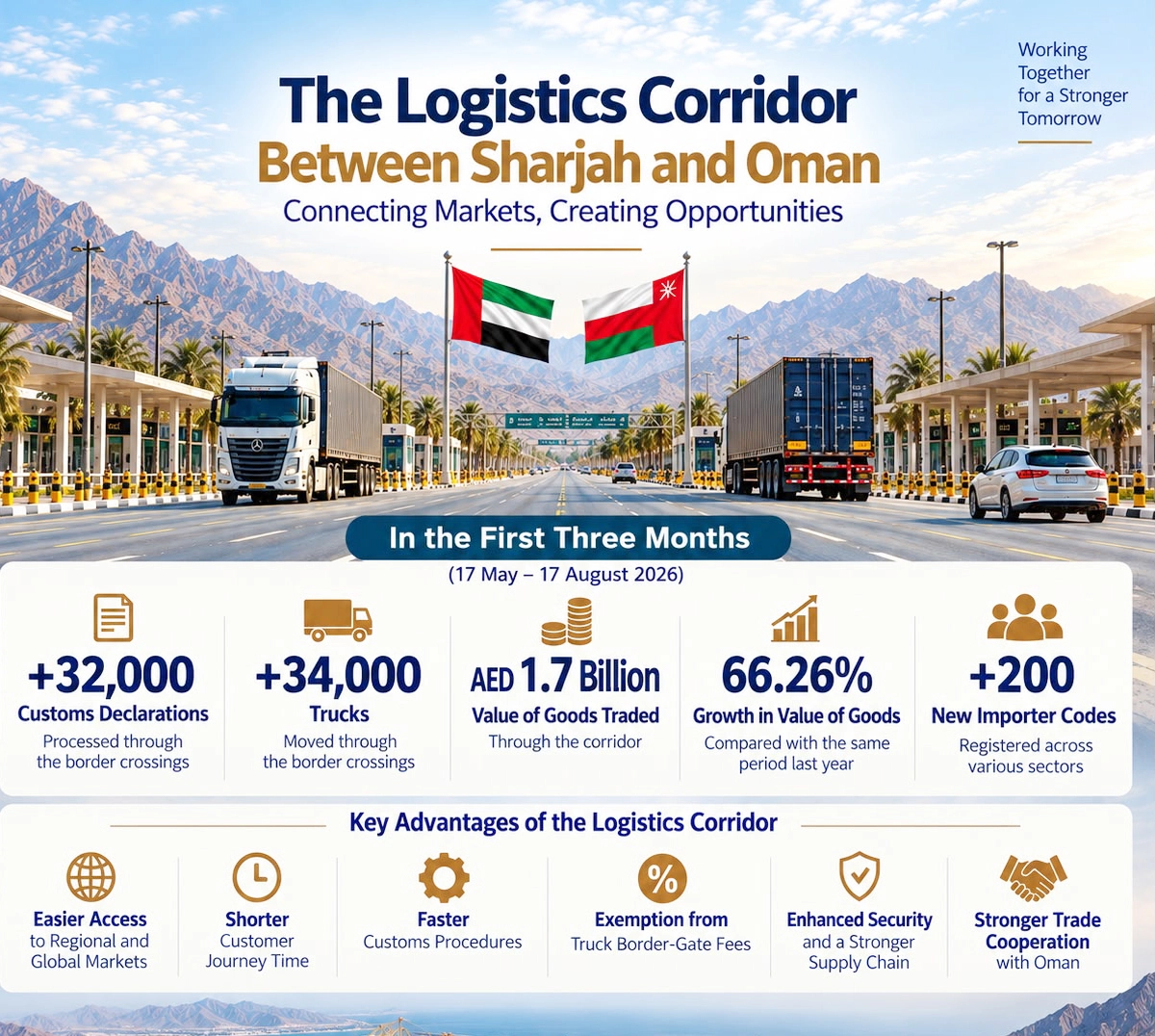
The Sharjah-Oman logistics corridor handled around Dhs 1.7 billion worth of cargo during its first three months, with more than 34,000 truck movements and over 32,000 customs declarations processed since its launch on 17 May 2026.
The figures point to rapidly growing use of the new sea-land trade route, with cargo value rising 66.26% compared with the same period a year earlier. The corridor is designed to give importers, exporters and logistics companies additional ways to move goods between the UAE, Oman and wider regional markets.
For businesses, the significance goes beyond the headline cargo value: the system links Sharjah’s ports and other UAE ports with Oman’s Sohar, Duqm and Salalah ports through two land crossings, creating alternative routes depending on cargo destination and logistics requirements.
Sharjah Oman logistics corridor connects ports with two land crossings
The corridor operates through the Khatmat Malaha Border Crossing in Kalba and Al Madam Border Crossing, extending into Oman.
The two-route structure is intended to give businesses greater flexibility in planning cargo movements. Khatmat Malaha has the added advantage of being about 70 kilometres from Sohar Port, while Al Madam connects with Oman’s main road network.
Together, the routes create a link between sea and land transport, allowing cargo to move between ports, border crossings and logistics hubs with fewer stages in the overall journey.
The network connects Sharjah’s port infrastructure with Sohar, Duqm and Salalah, while also linking with other UAE ports. This gives companies moving goods between the UAE and Oman, as well as onward to regional markets, more route options.
What the first three months mean for UAE businesses
The corridor’s initial performance suggests that demand is building among companies looking for integrated customs and logistics services.
More than 200 new importer codes were registered during the first months of operation. Goods moving through the network have included vehicles and equipment, food and agricultural products, building materials and spare parts.
The markets served so far extend beyond the UAE and Oman to include Saudi Arabia and markets in Africa and Asia, indicating that the corridor is being used for trade flows extending beyond the immediate UAE-Oman route.
For freight operators and logistics providers, the model is intended to reduce the number of handling stages and make it easier to select routes based on where goods are ultimately headed.
34,000 trucks and 32,000 customs declarations processed
The corridor recorded more than 34,000 truck movements and over 32,000 customs declarations during its first three months.
Cargo value reached approximately Dhs1.7 billion, representing a 66.26% increase year on year for the comparable period.
The Sharjah Ports, Customs and Free Zones Authority said the growth has been accompanied by an expanding customer base and increased demand for the corridor’s integrated customs and logistics services.
The figures also provide an early indication of the volume of activity being handled through the new system, although the corridor remains in its initial operating phase.
How the customs process is being integrated
The corridor was developed through coordination between Sharjah Customs, the Border Crossings and Entry Points Affairs Sector and other departments within the Sharjah Ports, Customs and Free Zones Authority, alongside relevant UAE federal and local entities.
On the Omani side, the project involves Oman Customs and other relevant authorities.
The participating entities worked on aligning operational and customs procedures, coordinating truck and cargo movements and speeding up transaction processing.
According to Mohammed Ibrahim Al Raisi, Director of Border Crossings and Entry Points Affairs at the Sharjah Ports, Customs and Free Zones Authority, this coordination has helped reduce customer journey times and improve coordination between cargo arrival and departure points.
The stated objective is to make the movement of goods more predictable while reducing some of the operational work involved in moving cargo through the different stages of the journey.
Why the Khatmat Malaha and Al Madam routes matter
Using both crossings gives the corridor an element of operational flexibility rather than relying on a single land route.
Khatmat Malaha is particularly relevant to cargo moving towards Sohar, given the border crossing’s proximity to the Omani port. Al Madam, meanwhile, provides access to the wider road network.
The complementary routes allow businesses to consider the destination and requirements of individual shipments when choosing how cargo should move between the UAE’s maritime infrastructure and Oman.
This is central to the corridor’s broader purpose: connecting ports, customs facilities, land crossings and free zones into a single logistics ecosystem rather than treating each stage of cargo movement separately.
More shipping companies and logistics providers targeted next
The next phase will focus on expanding the number of companies using the corridor and attracting additional shipping companies, shipping lines and logistics service providers.
The Sharjah Ports, Customs and Free Zones Authority also plans to broaden the services and routes available through the network.
The longer-term objective is to use Sharjah’s combination of ports, free zones and land border crossings to create a wider logistics platform connecting businesses with markets in the Gulf and beyond.
For UAE importers and exporters, the development adds another option to an already important regional trade network, while the early growth figures suggest that demand for the corridor is already extending across multiple product categories and markets.
tanvir@dubainewsweek.com
