

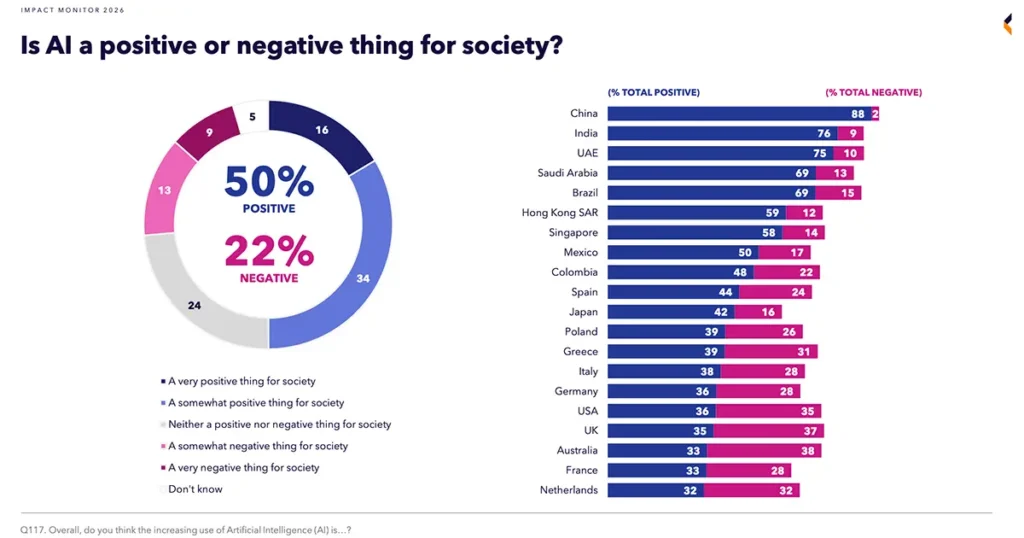
The UAE has ranked third among 20 markets worldwide for positive attitudes towards artificial intelligence (AI), with 75% of residents viewing its growing use as positive for society.
The findings come from the SEC Newgate 2026 Impact Monitor, which surveyed 20,473 people across 20 countries and territories.
The research highlights strong public confidence in AI’s potential to improve everyday life, economic growth and public services in the UAE.
Eight in 10 UAE respondents (80%) believe AI will make everyday life easier and more convenient, compared with 60% globally.
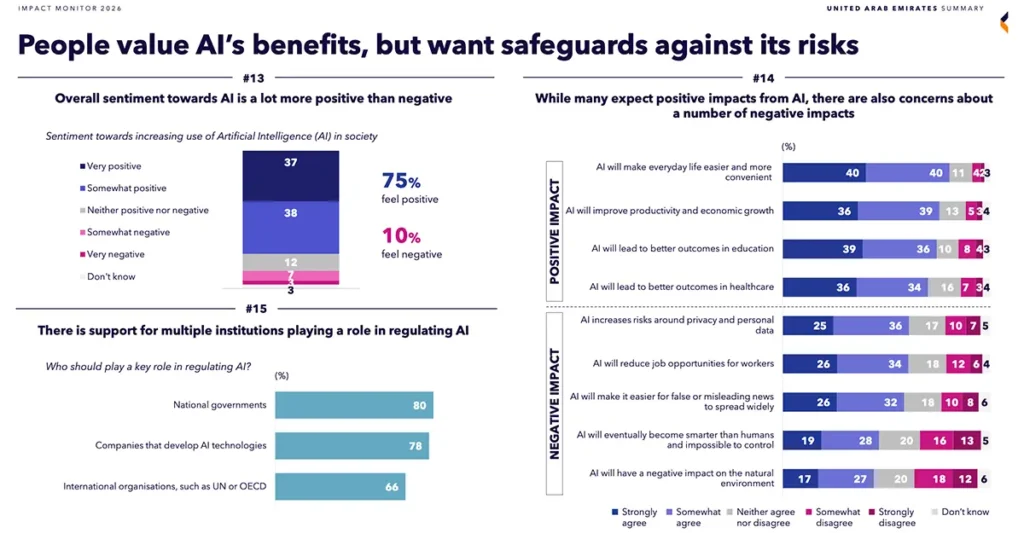
Meanwhile, 75% expect AI to improve productivity and economic growth, while the same proportion believe it will lead to better outcomes in education. Another 70% expect improvements in healthcare.
Privacy and jobs remain key AI concerns
Despite the overall optimism, UAE residents also recognise the potential risks of wider AI adoption.
The survey found that:
61% believe AI increases risks around privacy and personal data.
60% think AI will reduce job opportunities.
58% believe it will make false or misleading news easier to spread.
There is also strong support for shared responsibility in regulating AI. Around 80% of respondents believe national governments should play a role, while 78% identify AI technology companies and 66% international organisations such as the UN or OECD.
UAE records strong confidence in business responsibility
The report also highlights a positive picture of public confidence in businesses operating in the UAE.
While 90% of respondents believe large companies should conduct themselves responsibly, 86% rate their performance highly. This represents a credibility gap of just three percentage points, compared with seven points in 2025.
The UAE’s result contrasts with the global picture, where the gap between public expectations and perceived business performance stands at 23 percentage points.
Local investment also matters to residents, with 73% believing businesses should invest in the communities where they operate, even if this affects profitability.
Meanwhile, 57% support local manufacturing even if it results in higher costs for consumers.
99% believe UAE is heading in the right direction
The survey found that 99% of UAE respondents believe the country is heading in the right direction, compared with a global average of 49%. This is up from 98% in 2025.
Public support for the renewable energy transition is also high, with 91% expressing positive views, up one percentage point from the previous year.
However, 53% are concerned about potential increases in energy costs linked to the transition, while 59% believe businesses should prioritise reducing carbon emissions over keeping consumer costs low.
The cost of living remains another important issue, with 69% of respondents considering it a very important priority. Only 17% believe it is being poorly managed.
What the findings mean for UAE businesses
Commenting on the UAE results, John Hobday, CEO of SEC Newgate Middle East, said: “The UAE’s place among the world’s most optimistic markets about AI comes as little surprise. It is a global innovation hub with an established pattern of early adoption, from mobile technology to the widespread use of social and digital platforms for information dissemination, business and engagement. Over time, this readiness to embrace new technologies and put them to practical use has become part of the country’s unmistakable economic and social character.
“The same forward-looking attitude appears across other indicators, such as the exceptionally strong public support for the renewable energy transition. Clean energy has been a national priority for many years, and the report suggests that the country’s ambitions are shared by the wider public. The common thread is an appetite for progress and a confidence in the opportunities that change can bring.
“For businesses, the findings offer grounds for cautious optimism. The UAE is a market where ambitious ideas can find a receptive audience. Yet public confidence carries its own expectations, and the organisations best placed to benefit will be those that harness new technologies to achieve commercial success while delivering the real-world benefits that communities expect.”
The global report surveyed 20,473 people and found that 80% believe responsible business conduct is important, but only 56% rate large companies’ performance highly.
It suggests that businesses need to demonstrate their contribution through local employment, investment, manufacturing and community initiatives, while addressing public concerns about affordability, security and technological change.
tanvir@dubainewsweek.com
