
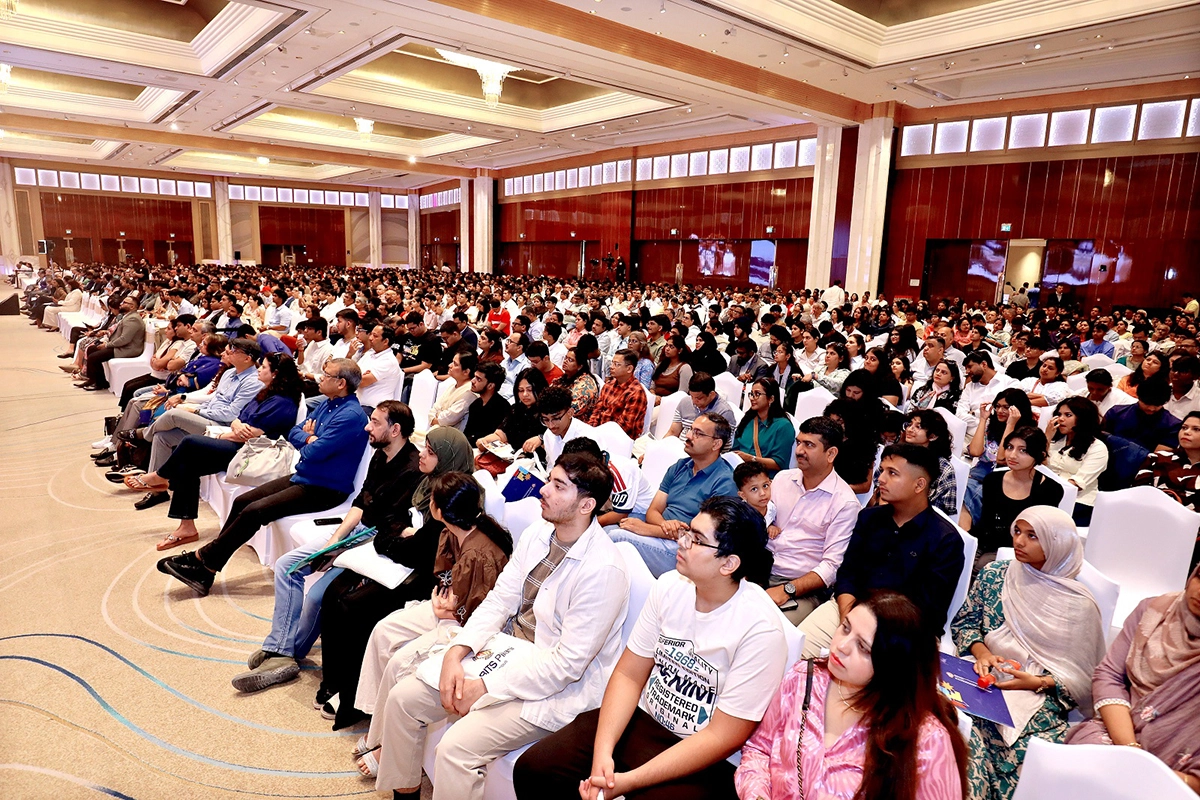
More than 60 percent students joining one of Dubai’s universities for the 2026–27 academic year have come from outside the UAE, offering a snapshot of how international the emirate’s higher-education student population has become.
The latest intake at BITS Pilani, Dubai Campus includes students from 13 nationalities, with newcomers from countries including India, Nigeria, Thailand and the United States, as well as Bahrain, Qatar, Oman, Kuwait and Saudi Arabia.
Close to 1,000 students have joined undergraduate, postgraduate and doctoral programmes for the new academic year. While the figures come from a single institution, they arrive against wider growth in UAE higher education, where new enrolments increased by 13% year-on-year in 2024–25, according to figures cited in the announcement from the Ministry of Higher Education and Scientific Research.
Dubai’s universities are attracting students from abroad
The international make-up of the new intake is one of the clearest indicators in the figures.
More than 60% of the students joining the Dubai campus this year are from outside the UAE. That includes students from the Gulf as well as countries in Asia, Africa and North America, giving the incoming cohort a notably international profile.
For families considering higher education in the UAE, the figures also highlight that Dubai’s university sector is serving a student population that extends well beyond residents already living in the country.
The release does not provide a breakdown showing how many of the international students are relocating to Dubai specifically for university, so the figures should not be interpreted as a measure of new arrivals to the emirate.
Which subjects are students choosing?
The intake also provides a glimpse into the programmes attracting students.
Engineering, technology and business make up the main academic areas, with 15 first-degree programmes, four master’s programmes and doctoral studies available to the incoming cohort.
First-degree programmes account for 82% of admissions, followed by master’s programmes at 14% and doctoral studies at 4%.
Admissions increased compared with the previous year in Electronics and Communication Engineering, Mathematics and Computing, and Robotics and Industrial Automation. The release does not provide the number or percentage increase for each programme, so the scale of the change is not clear.
The pattern nevertheless shows that technology-focused subjects are among the areas seeing stronger admissions at the campus this year.
UAE higher education enrolments are also rising
The university’s intake comes as the UAE’s wider higher-education system continues to expand.
According to the figures cited by BITS Pilani, new enrolments across UAE higher education grew 13% year-on-year in 2024–25, reaching the highest intake in a decade. Registrations in the previous academic year also reached their highest level in five years.
Those national figures provide broader context for the Dubai intake, although they do not establish how much of the overall growth is being driven by international students.
What does the new intake look like?
The incoming cohort is made up of 32% female students and 68% male students, according to the announcement.
Students are enrolled across undergraduate, postgraduate and doctoral programmes, creating a mix of first-degree students, master’s students and researchers on the campus.
The institution held orientation programmes for the new students during the last week of August.
For Dubai, the more significant takeaway is the combination of international demand and continued enrolment growth: the latest figures show students from multiple regions choosing UAE-based higher education while the country’s university sector continues to expand.
The announcement does not provide figures for the total number of international students across all UAE universities, so it is too early to use this intake alone to quantify the country’s overall international student market.
tanvir@dubainewsweek.com
