
Dubai Metro Blue Line construction has reached 29% completion, with tunnel excavation more than halfway finished and new train and station designs unveiled.
The Roads and Transport Authority (RTA) has confirmed that overall construction of the 30km Dubai Metro Blue Line has reached 29%, with more than 14,000 workers contributing over 33 million working hours to the project.
The latest progress figures show that tunnel excavation is 55% complete, while underground stations have reached 32% completion.
Construction of elevated stations stands at 16%, while bridge works have reached 17%. Work on the bridge piers is further advanced, with 62% completion.
Sheikh Hamdan bin Mohammed bin Rashid Al Maktoum, Crown Prince of Dubai, Deputy Prime Minister and Minister of Defence, reviewed the construction progress during a visit to the project site in Dubai Festival City.
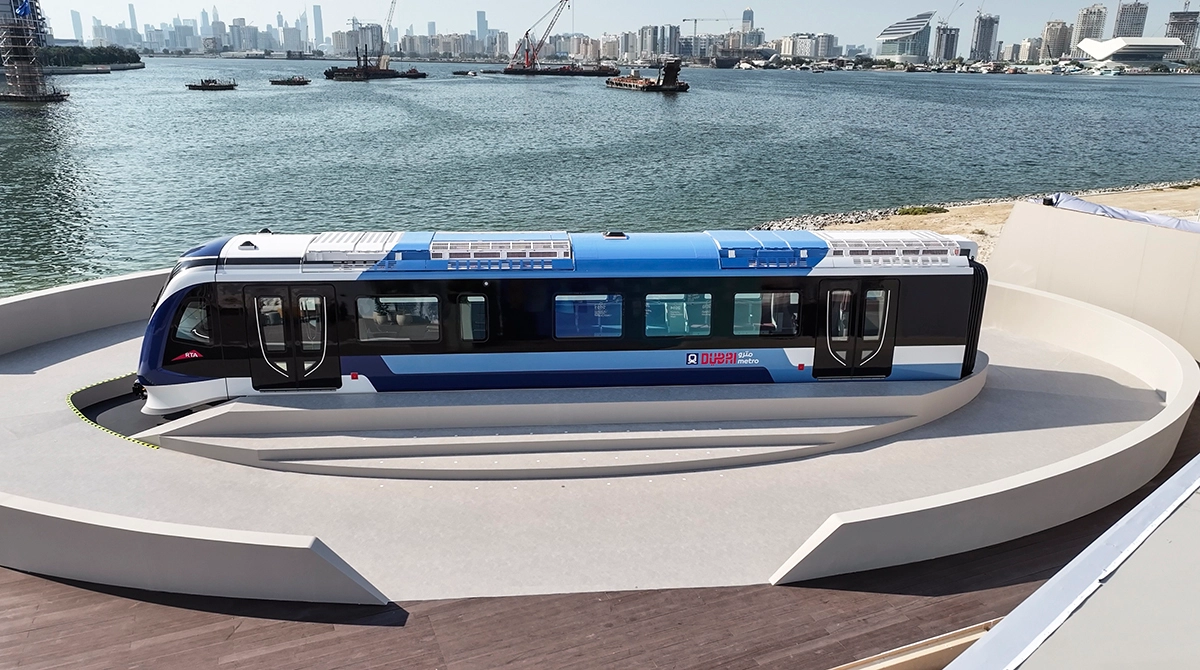
During the visit, Sheikh Hamdan reviewed the new design of the Blue Line trains, which will have a design capacity of 675 passengers per journey and a total capacity of 1,246 passengers.
The trains will feature three passenger categories: Gold Class, Silver Class and a dedicated carriage for women and children.
Gold Class will include contemporary seating, wireless charging facilities, digital screens and intelligent lighting that adjusts automatically to surrounding conditions. Its ceiling design will also feature a starry-sky theme.
Silver Class and the women and children’s carriage will focus on passenger capacity, comfort and ease of movement, with large windows and digital screens displaying routes and station information.
The new trains will also incorporate smart cameras to detect obstacles on the tracks, monitor passenger numbers and measure carriage occupancy in real time.
Dubai Creek bridge and station designs
The visit also covered the engineering work on the Blue Line’s 1.3km bridge across Dubai Creek.
The bridge will be the first Dubai Metro crossing over the Creek and is one of the project’s major engineering components.
Its construction uses precast concrete segments installed using specialised cranes and platforms operating from completed bridge piers. The approach reduces reliance on floating cranes and temporary marine platforms, allowing boats and other marine traffic to continue moving through the Creek during construction.
The RTA also presented the interior designs for the Blue Line’s stations, which will follow five architectural concepts.
These include the iconic Emaar Properties Station, inspired by the idea of a crossing gateway, alongside four designs based on the natural elements of water, air, fire and earth.
The designs will incorporate open spaces, natural light, flowing lines and nature-inspired colours.
New railway technologies to improve safety and maintenance
The Blue Line project also includes new technologies designed to improve railway operations and infrastructure maintenance.
One of these is the Automated Rail Infrastructure Inspection System (ARIIS), developed by the RTA’s Rail Agency.
The mobile system uses LiDAR technology and artificial intelligence to inspect railway infrastructure, identify defects and recommend maintenance requirements.
Its targets include reducing inspection time by 80%, cutting resource use by 50% and collecting and analysing ten times more data. It also aims to improve safety by 50% and increase early fault detection and reliability by 90%.
The RTA is also establishing a research and development centre and innovation laboratory in collaboration with railway technology company CASCO SIGNAL LTD.
The facility will be used to test signalling, communications and train control systems under simulated operating conditions before they enter service.
According to the RTA, the laboratory is expected to reduce testing time by 85% and improve the accuracy of the train punctuality indicator to more than 99.7%.
Areas connected by the 30km Blue Line
The Dubai Metro Blue Line will extend the existing network through 14 stations, including three interchange stations connecting passengers to the Red and Green Lines and linking the two Blue Line branches.
The route will serve several residential, commercial and educational areas, including:
- Mirdif
- Al Warqa’a
- International City
- Dubai Silicon Oasis
- Dubai Academic City
- Dubai Festival City
- Dubai Creek Harbour
The 30km route will comprise 15.5km of underground track and 14.5km above ground.
The project is designed to improve connections between residential communities, business districts, educational institutions and developing areas across Dubai.
It also supports the Dubai 2040 Urban Master Plan, which aims to encourage development around public transport stations and improve access to key destinations through sustainable transport options.
tanvir@dubainewsweek.com
