
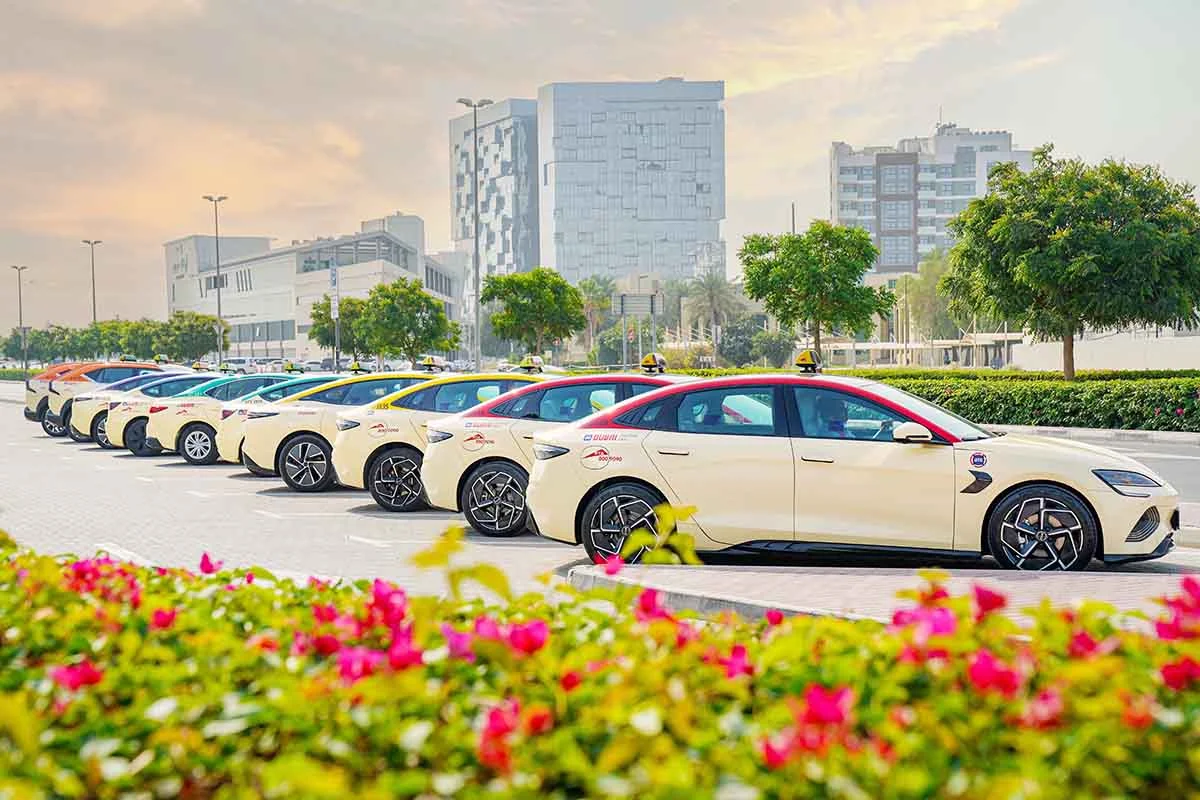
Dubai residents and visitors will be able to see how taxi companies perform under a new five-star rating system launched by the Roads and Transport Authority (RTA), which links company ratings to service quality, safety and customer satisfaction.
The system will assess taxi operators across 18 indicators, covering everything from vehicle cleanliness and driver behaviour to digital payments, accident records and the availability of taxis during peak hours.
How Dubai’s five-star taxi rating system works
The new system evaluates taxi companies against four main pillars: sustainability, technology, accountability and reliability.
These cover 18 performance indicators designed to measure the quality and efficiency of taxi services across Dubai.
The assessment includes:
- Sustainability: The number of electric and hydrogen vehicles, vehicle utilisation, productive kilometres and average trip ratings.
- Technology: The use of e-hailing services, electronic payments, driver management systems and compliance with driver working-hour policies.
- Accountability: Serious traffic accidents, service violations, reckless driving complaints and customer and driver satisfaction.
- Reliability: Taxi availability during peak hours, driver acceptance of e-hailing requests and vehicle cleanliness.
The ratings will be displayed on smart screens inside taxis, allowing passengers to see how their taxi company performs.
Five-star taxi companies to receive additional taxi permits
RTA will link company ratings to incentives and performance improvement measures.
Companies awarded five stars will receive seven additional taxi plates, along with a certificate and trophy from RTA. Four-star companies will receive five additional taxi plates.
Operators rated three stars or fewer will be subject to measures aimed at improving their performance and service standards.
RTA said the system will also be reviewed periodically to keep pace with developments in the transport sector.
Five companies operate Dubai’s taxi sector
Dubai’s taxi sector comprises five companies: Dubai Taxi Company, Kabi Taxi, National Taxi, Arabia Taxi and Metro Taxi.
In 2025, the emirate had more than 14,346 taxis, of which 12,380 were electric or hybrid vehicles.
The fleet completed more than 120 million trips, carrying over 209 million passengers during the year.
Taxis accounted for 27 per cent of all users of public transport, shared mobility and taxi services in Dubai in 2025.
Dubai targets zero-emission public transport
The new taxi rating system also supports Dubai’s wider plans to develop more sustainable transport services.
RTA aims to transition the emirate’s public transport system fully to zero-emission operations by 2050.
The share of green vehicles, including hybrids, in Dubai’s taxi and limousine fleet has exceeded 72 per cent, while the transition to electric vehicles has reached 19 per cent, surpassing the target set for 2026.
RTA also plans to convert its entire taxi and limousine fleet to electric and hydrogen vehicles by 2040.
The authority is expanding trials and the introduction of autonomous electric vehicles, while developing fast-charging infrastructure across public parking areas and major transport facilities.
